Blog | The 4 Campaigns We ALWAYS Use To Scale High Ticket Info Product Offers

I hope this blog post is of value to you. If you want to apply to work with my team, click here.
Author: Mike Haugen | Founder of Norse Marketing.
Published October 5th, 2025
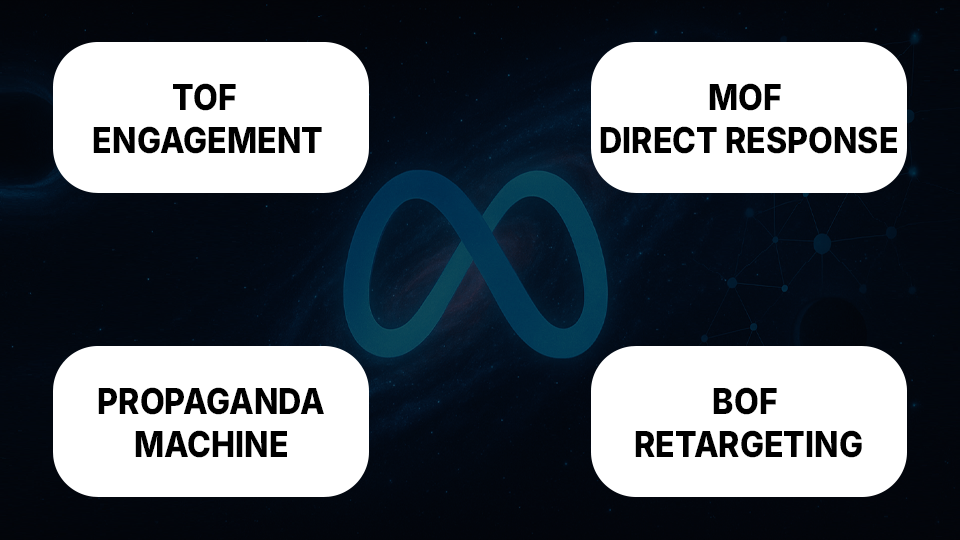
This article is all about generating appointments with Meta ads for high ticket offers.
The days where you could run direct response ads to cold traffic are over. Now, you need ad campaigns that takes people through organic traffic before they're ever hit with direct response.
After spending millions on Facebook ads, we’ve found that almost everyone overcomplicates their ad structure.
The truth is, you don’t need a dozen campaigns or 50 interest stacks.
You need a simple system that feeds Meta’s algorithm the right data and allows it to optimize properly.
This is the exact ad structure we use on every 7-figure info product we manage.
Why Most Ad Accounts Fail
Most advertisers build their campaigns like this:
Too many campaigns.
Too many ad sets targeting overlapping audiences.
Too few creatives inside each ad set.
That old structure worked five years ago, before Meta’s delivery algorithm evolved.
Today, the algorithm thrives on creative diversity and simplified structure.
When you fragment data across 10 campaigns and 50 audiences, Meta’s system can’t learn who your best buyers are.
That’s why the new era of media buying is about fewer moving parts and more creative fuel.
The 4-Campaign Structure That Scales
At Norse Marketing, every high-performing info product account we manage follows the same structure:
Campaign #1 — Top of Funnel (TOF)
The goal here is simple: build awareness and create demand.
Campaign Type: Engagement Campaign
Optimization: Through Plays
Conversion Location: Follows (so people follow your page or profile)
Exclusions: Page Views and Followers (avoid overlap)
Creative Type: Educational videos, social proof, authority content
Think of this as your “warm-up machine.” These ads aren’t selling — they’re teaching, proving, and positioning you as the go-to expert.
Campaign #2 — Middle of Funnel (MOF)
This is where you switch to direct response.
You’re targeting everyone who’s already engaged with you — people who:
Follow your page
Liked, commented, or shared your content
Visited your profile
Campaign Type: Lead Campaign
Objective: Conversion (application or booking)
Creative Type: Direct response video ads work the best, but also fill this campaigns with all types of creative types.
This is where your call funnel lives.
Your ads should lead to your VSL page or application funnel — not to a random landing page.
Campaign #3 — Bottom of Funnel (BOF)
This is the retargeting campaign where you hammer them with social proof.
Target everyone who has visited your website in the last 180 days.
Campaign Type: Lead Campaign
Creative Type: Testimonial clips, case studies, results videos
At this stage, your goal is simple: remind and convert.
You’re not educating anymore — you’re reinforcing proof and urgency.
Campaign #4 — Propaganda Campaign
This is the back-end ad campaign that we run to all the people who have scheduled a sales call with us.
It's going to be a rotating 7-day audience where people are added when they book a call, and taken out after 7 days.
If you don't have 100 calls booked within a 7-day period, add applications, and if you don't have 100 applications over a 7-day period, add optins (if you have an optin page).
P.S. Also add every registration to your webinars/challenges in here as well.
Here are the campaign specifics:
- Engagement campaign: Video views - ThruPlays
- Target calls/apps/optins
- Have 1 ad/ad set
- Exclude people who have seen 3 seconds of the ad in that ad set (this ensures that people only see every ad once.
- Aim for a 15-20 frequency within a 72-hour window.
You'll need to create 1 main custom audience that every ad set targets, and 1 custom audience for every ad in the campaign so you can do the 3-second exclusion for every ad set.
This will push people through a ton of value/social proof/objection handling content before they even jump on a sales call or your webinar/challenge.
Which again will increase your show-up rate & closing rate (because the closer will spend less time educating and more time selling).
Alternative TOF Campaign
Now, for niches where you need to educate people more on the front-end, you need a different setup.
For 'saturated niches', such as e-commerce, agencies, trading etc - you don't need this setup.
But for other niches, such as government contracting (which is the niche one of our most successful clients are in), people need to be sold on why it even makes sense in the first place. Most people don't even know what it is.
For that campaign, the idea is to force people through a series of 3 different video ads before they are targeted with any direct response.
For our original TOF campaign, the audience is just hammered down with organic content before they are hit with direct response after they visit or follow the profile.
This is the setup:
### Video 1: An introductory video that grabs attention and frames the opportunity
- Targeting: Broad
- Exclude: People who watched 25% of video 1 (this makes sure that when they have seen 25% of this video, they won't see it again. You set this up by creating a video custom audience for this specific video and excluding it in the ad set the video is in.
### Video 2: A detailed case study that builds credibility.
- Targeting: People who watched 25% of video 1
- Exclude: People who watched 25% of video 2
### Video 3: An expertise and objection-handling video.
This video tackles objections head-on, discussing:
Complexity Myths: Simplifying concepts to show they’re manageable.
Risk Concerns: Explaining how proper planning reduces risk.
Accessibility: Demonstrating that these strategies are within reach.
By the time viewers have engaged with all three videos, they’ve been educated on the problems they didn’t know they had and are primed for the solution you offer.
- Targeting: People who watched 25% of video 2
- Exclude: People who watched 25% of video 3
The Big Takeaway
Stop trying to out-think the algorithm.
Feed it structure and scale, not chaos.
Simplify your setup:
1 Top of Funnel campaign (education + social proof).
1 Middle of Funnel campaign (direct response).
1 Bottom of Funnel campaign (testimonials + case studies).
Then, pump out 20–40 unique creatives across those three layers.
Do this, and your campaigns will stabilize, your cost per call will drop, and your scaling ceiling will rise.


This site is not a part of the Facebook website or Facebook Inc. Additionally, This site is NOT endorsed by Facebook in any way. FACEBOOK is a trademark of FACEBOOK, Inc.
DISCLAIMER: The sales figures stated above are personal sales figures. Please understand the results are not typical, I’m not implying you’ll duplicate them (or do anything for that matter). The average person who buys any "how to" information gets little to no results. I’m using these references for example purposes only. Your results will vary and depend on many factors… including but not limited to your background, experience, and work ethic. All business entails risk as well as massive and consistent effort and action. If you're not willing to accept that, please DO NOT WATCH THIS FREE TRAINING.